
Territorial Gain Index
Alright, more World Cup 2026-themed analysis here.
This is a continuation of yesterday’s post, because I still had an “intellectual itch” that desperately needed scratching.
Today, I finally managed to compile every nation eliminated during both the second-round group stage and the third-round group stage.
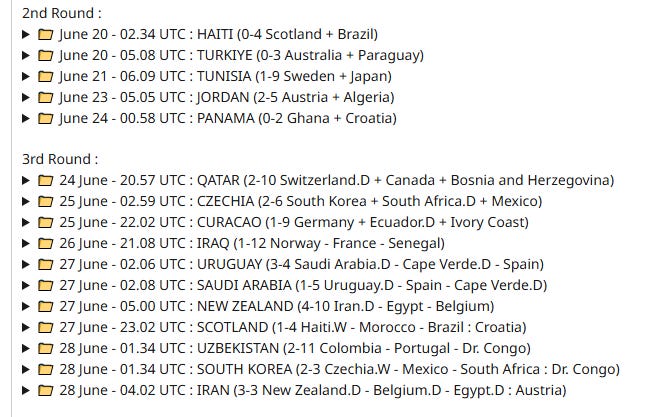
For every group, at least one nation is eliminated outright: the team finishing fourth.
That raises an interesting question: who gets “credited” with eliminating that nation? Does every other team in the group share the credit?
No.
Only the nation that actually defeated them in a head-to-head match gets the elimination. Draws don’t count.
The third-place scenario is much trickier.
Four third-placed teams were eventually eliminated: Uruguay, Scotland, South Korea, and Iran.
Uruguay is a special case. Although they finished third, they never really entered the race for the best third-placed teams because their point total was simply too low to compete with the other third-placed nations.
The other three are much more interesting.
Their eliminations came from outside their own groups through the race for the best third-placed teams. Croatia remotely eliminated Scotland. DR Congo remotely eliminated South Korea. Austria remotely eliminated Iran. All three deserve credit for those eliminations.
Looking at the complete “who eliminated whom” table, most nations eliminated only one opponent. However, four countries managed to eliminate two nations each: Croatia, Spain, Brazil, and Austria.
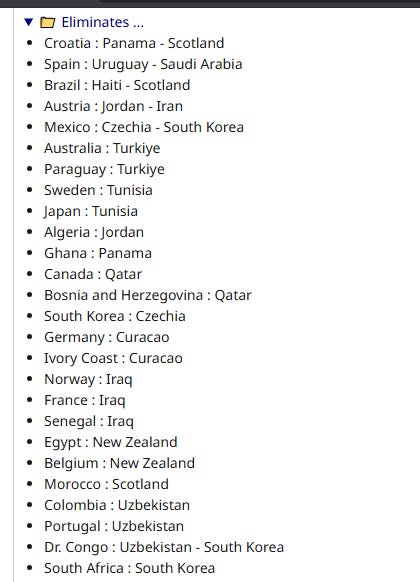
Croatia and Austria each eliminated one nation directly within their own group, then claimed another elimination remotely through the best third-place race.
Spain, Brazil, and Mexico simply bulldozed through their groups by winning on the pitch. No fancy “remote mathematical elimination” was needed.
Now imagine this (fictional) scenario :
Whenever a country eliminates another country, it inherits all of that country’s territory. Apply this rule recursively from the qualification rounds all the way through the World Cup itself.
Now, which country ends up ruling the largest empire?
I asked Gemini to write a script that calculates this “Territorial Gain Index.”
The result surprised me.
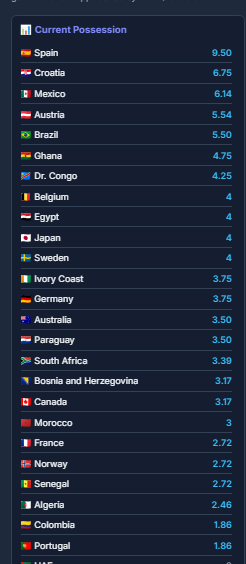
Spain finished first with a domination score of 9.50, while Brazil only reached 5.50.
Why?
Spain defeated Uruguay, who already possessed Venezuela, Peru, Chile, and Bolivia, as well as Saudi Arabia, who controlled Bahrain, Indonesia, Pakistan, Tajikistan, and China.
Brazil, meanwhile, defeated Haiti, who possessed Costa Rica, Barbados, Aruba, Saint Lucia, Honduras, and Nicaragua, before later eliminating Scotland, who possessed Denmark, Greece, and Belarus.
Here’s the catch.
Brazil didn’t eliminate Scotland alone.
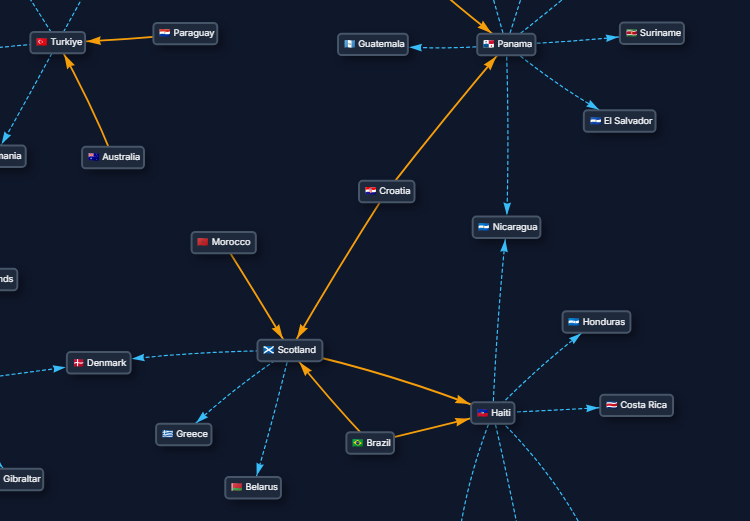
Morocco defeated Scotland on the field, Brazil defeated Scotland, and Croatia remotely executed Scotland through the best third-place race. Now, Scotland was effectively occupied by an allied coalition.
That means Brazil isn’t the sole sovereign over Scotland. Any territorial gains from Scotland would likely require a partition agreement among the victorious allies: Brazil, Morocco, and Croatia.
There’s another complication.
Scotland also contributed to Haiti’s elimination. That means Brazil’s claim over Haiti is already diluted before Scotland even falls. Brazil’s occupation of Haiti would also have to be negotiated with Scotland’s successors.
Spain’s situation is much simpler.
Spain defeated Saudi Arabia alone. Within Group H, Spain was the only nation to beat Saudi Arabia, winning 4-0. Cape Verde and Uruguay could only draw against them.
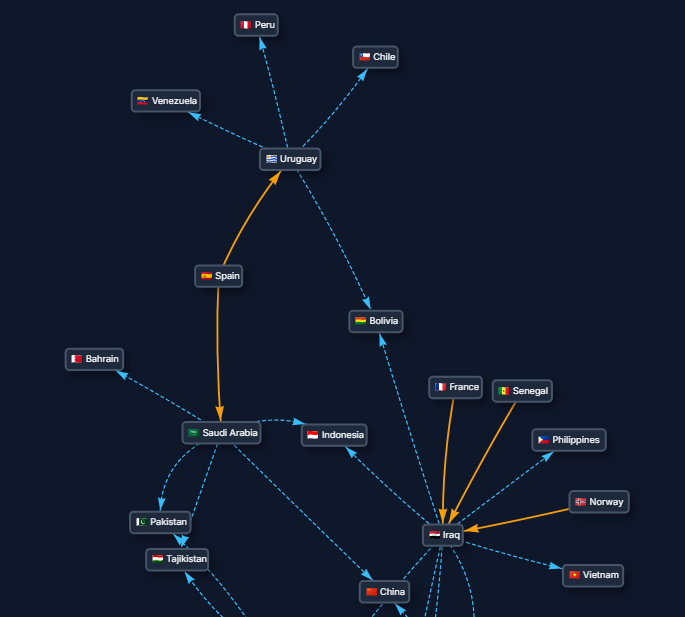
As a result, every territory owned by Saudi Arabia passed directly to a single emperor: Spain.
Well... almost.
Saudi Arabia only had full control over Bahrain.
The rest of its territories were already under shared control with other World Cup-qualified nations. Indonesia was jointly controlled with Iraq. Pakistan and Tajikistan were shared with Jordan. China was shared with South Korea.
So Spain’s undisputed empire consists of Uruguay, Venezuela, Peru, Chile, Saudi Arabia, and Bahrain, giving them a World Domination score of 9.50.
Second place belongs to Croatia.
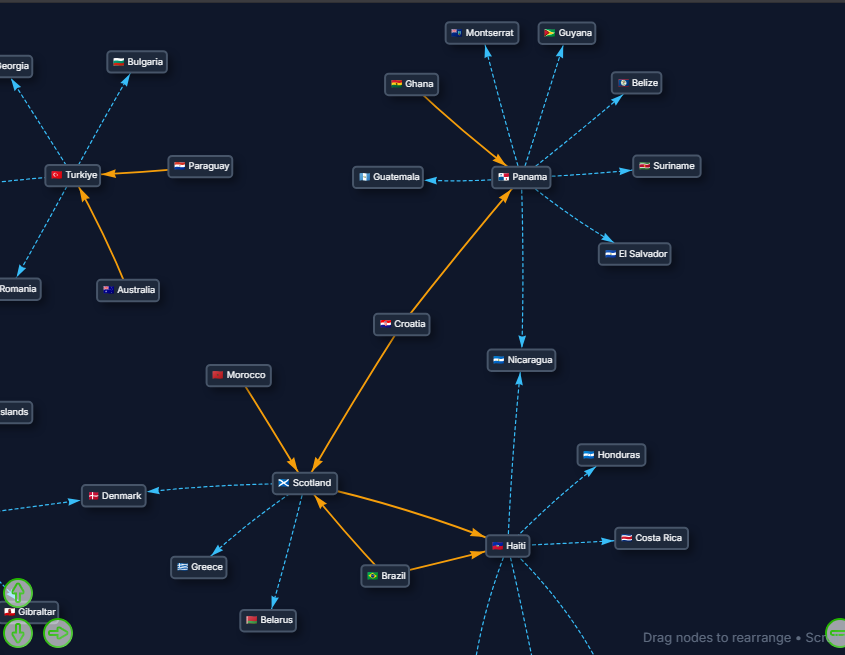
Croatia defeated Panama directly in a 1-0 victory while also remotely eliminating Scotland.
Croatia doesn’t enjoy full control over Panama, however, because Ghana also contributed to Panama’s elimination with a 1-0 victory. Every Panamanian possession—Guatemala, Montserrat, Belize, El Salvador, Suriname, and Guyana—must therefore be jointly administered by Croatia and Ghana.
Nicaragua is even messier because it was already jointly controlled by Haiti and Panama from the beginning.
Croatia’s claim over Scotland is similarly diluted, since Scotland was occupied collectively by Morocco, Brazil, and Croatia. Scotland’s only uncontested possessions were Greece and Belarus, while Denmark was itself jointly controlled through Czechia.
As a result, Croatia doesn’t enjoy absolute sovereignty over any major country. Its influence is spread remarkably far, but very thin. Its sphere of influence stretches across Panama, Guatemala, Montserrat, Belize, El Salvador, Suriname, Guyana, Nicaragua, Scotland, Belarus, Greece, Denmark, Haiti, Honduras, Costa Rica, Barbados, Saint Lucia, and Aruba.
Finally comes Mexico with a domination score of 6.14.
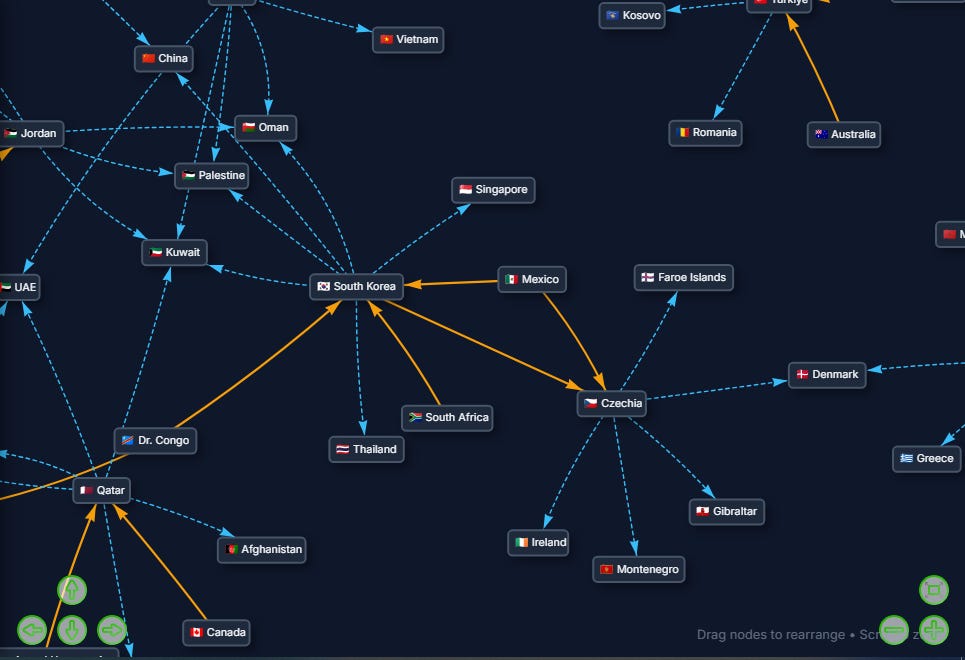
Like Brazil, Mexico directly eliminated opponents through head-to-head victories, beating Czechia 3-0 and South Korea 1-0.
But just like Croatia, Mexico wasn’t solely responsible for either elimination.
Mexico received help from South Korea in eliminating Czechia.
Later, in eliminating South Korea, Mexico was assisted by its African allies: DR Congo and South Africa.
As a result, Mexico’s control over the European sphere—Czechia, Denmark, the Faroe Islands, Gibraltar, and Ireland—must first be negotiated with South Korea.
Meanwhile, its claim over the Asian sphere—South Korea, Singapore, Thailand, Kuwait, Oman, Palestine, and China—must be shared with DR Congo and South Africa.